Why Hardware Security Keys Are No Longer Just for Enterprises
Cyber Security

By Sreenivas K. | Published on June 20, 2026 | 4 min read
Cyber Security
By Sreenivas K. | Published on June 20, 2026 | 4 min read
Only a few months ago, hardware security keys were still largely viewed as enterprise infrastructure. They belonged inside large banks, Fortune 500 companies, government organizations, casinos, critical infrastructure providers, and highly regulated industries.
For the average professional, they felt distant. Today, that perception is changing rapidly.
The cybersecurity landscape has reached an inflection point where enterprise-grade authentication is no longer a luxury, it is becoming a necessity for anyone whose digital identity matters.
The catalyst is not one single breach or one new technology.
It is the convergence of several developments that are fundamentally reshaping how the world thinks about identity.
When OpenAI advised using hardware-backed authentication with FIDO2 security keys, it wasn't simply introducing another login option.
It was acknowledging something much bigger.
The world's leading AI companies are now publicly recognizing that passwords, OTPs, and even traditional multi-factor authentication are approaching their limits.
Identity has become the new security perimeter.
The timing could not be more significant. Over the past year, the cybersecurity industry has witnessed an unprecedented series of developments.
Google recently disclosed one of the first known AI-assisted zero-day exploit workflows, demonstrating how artificial intelligence can accelerate vulnerability discovery and exploitation.
Supply-chain attacks have compromised thousands of repositories through poisoned developer packages and extensions. Credential theft has evolved from isolated phishing campaigns into sophisticated attacks targeting developers, administrators, cloud infrastructure, and privileged identities.
Meanwhile, AI-generated phishing, deepfake impersonation, and autonomous attack agents are steadily changing the economics of cybercrime.
The common thread across all these developments is surprisingly simple.
And that reality no longer applies only to large enterprises.
Today's developer safeguards production code and cloud infrastructure. A startup founder manages customer data and financial platforms. Consultants access confidential client systems every day. Creators, freelancers, and remote professionals rely on digital identities that now underpin their businesses and livelihoods.
Yet while the value of their digital assets has grown exponentially, the way they protect them has barely changed. Passwords, OTPs, and conventional authentication methods were built for a very different internet, one that did not have AI-assisted attacks, sophisticated phishing, or cloud-native workflows.
Enterprise-grade threats are no longer confined to enterprise environments. Which is why enterprise-grade authentication should no longer be confined there either.
For Ensurity, this transition is not new. Long before hardware-backed authentication became mainstream conversation, Ensurity was designing authentication ecosystems for organizations where identity could never become the weakest link.
Over the past decade, we helped secure environments where authentication is directly tied to business continuity, regulatory compliance, and operational resilience. These deployments span highly regulated industries, global hospitality organizations, financial institutions, enterprise technology environments, and critical infrastructure.
The lesson from every deployment has been remarkably consistent.
Authentication is never just about logging in. It is about establishing trust.
That philosophy led to the development of the ThinC-AUTH ecosystem, a complete authentication platform built around hardware-backed identity, FIDO2 standards, sandboxed biometrics, immutable cryptography, and enterprise-scale governance.
The answer lies in how rapidly the authentication landscape is evolving.
The United States has emerged as the epicentre of the shift towards hardware-backed authentication. For Ensurity, this isn't a new market, it is one where our authentication solutions have already secured some of the world's most demanding enterprise environments across industries including financial services, hospitality, gaming, and technology. Today, those same enterprise-grade security principles are protecting organizations where identity is mission-critical.
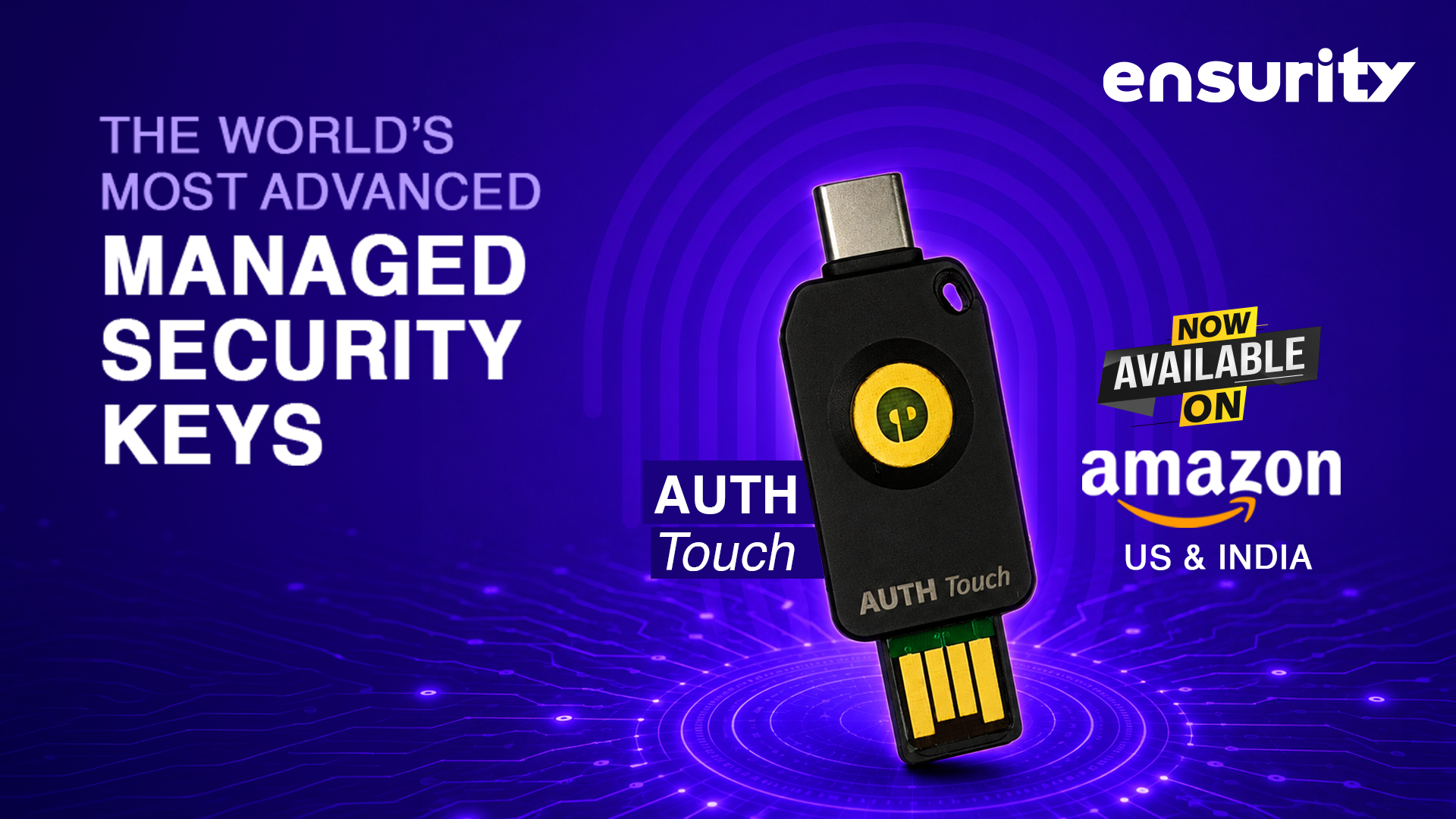
Listing the ThinC-AUTH Security Key ecosystem on Amazon US is the natural next step. It makes the same trusted FIDO2 authentication technology accessible not only to large enterprises, but also to developers, startups, consultants, small businesses, remote professionals, and security-conscious individuals looking to strengthen their digital identities.
Because the future of authentication should not be limited by the size of an organization. It should be available to everyone who values trust.
To support this vision, Ensurity has brought two purpose-built FIDO2 security keys from its ThinC-AUTH ecosystem to Amazon, each designed for a distinct authentication journey while sharing the same foundation of hardware-backed trust and phishing-resistant security.
ThinC-AUTH Touch is Ensurity's FIDO2-certified security key built for secure, everyday authentication. Designed for professionals, developers, remote workers, and security-conscious individuals, it delivers passwordless authentication through hardware-backed public key cryptography and capacitive touch-based user presence verification. Compact, portable, and easy to deploy, it brings enterprise-grade authentication within reach of every professional.
For users looking to extend the same level of security across their home or personal workspace, ThinC-AUTH Desktop BioPro offers a unique approach to shared authentication. Supporting up to three independently enrolled users on a single device, it allows families, home offices, and shared workspaces to securely access the same computer without relying on shared passwords or compromising individual privacy.
Imagine a family where parents and children each have their own secure digital identities on a shared desktop. Or a home office where business and personal accounts remain completely separate, while every login is protected by hardware-backed FIDO2 authentication and on-device biometric verification. Each user authenticates using their own enrolled fingerprint, with biometric data securely stored within the device itself, not on the computer or in the cloud.
As digital identities become increasingly valuable, enterprise-grade authentication is no longer just for the workplace. With ThinC-AUTH Desktop BioPro, the same trusted security architecture can now protect the people closest to you.
Together, ThinC-AUTH Touch and ThinC-AUTH Desktop demonstrate Ensurity's vision of making enterprise-grade, hardware-backed authentication accessible to everyone, from individual professionals protecting their digital identities to organizations securing thousands of users at scale.
The industry has spent years talking about passwordless authentication. But perhaps that was only the beginning.
The next evolution is not simply eliminating passwords.It is establishing trust through hardware.
Authentication is becoming cryptographic.
Identity is becoming hardware-backed. Security is becoming personal.
The technologies once reserved for the world's largest enterprises are now becoming accessible to every developer, every professional, every business, and every individual.
The future of authentication will not be defined by stronger passwords, but by stronger proof of identity. As AI reshapes the threat landscape, hardware-backed trust will become the new standard for everyone, not just enterprises. Because in the years ahead, the strongest security won't be what you remember. It will be what you carry.