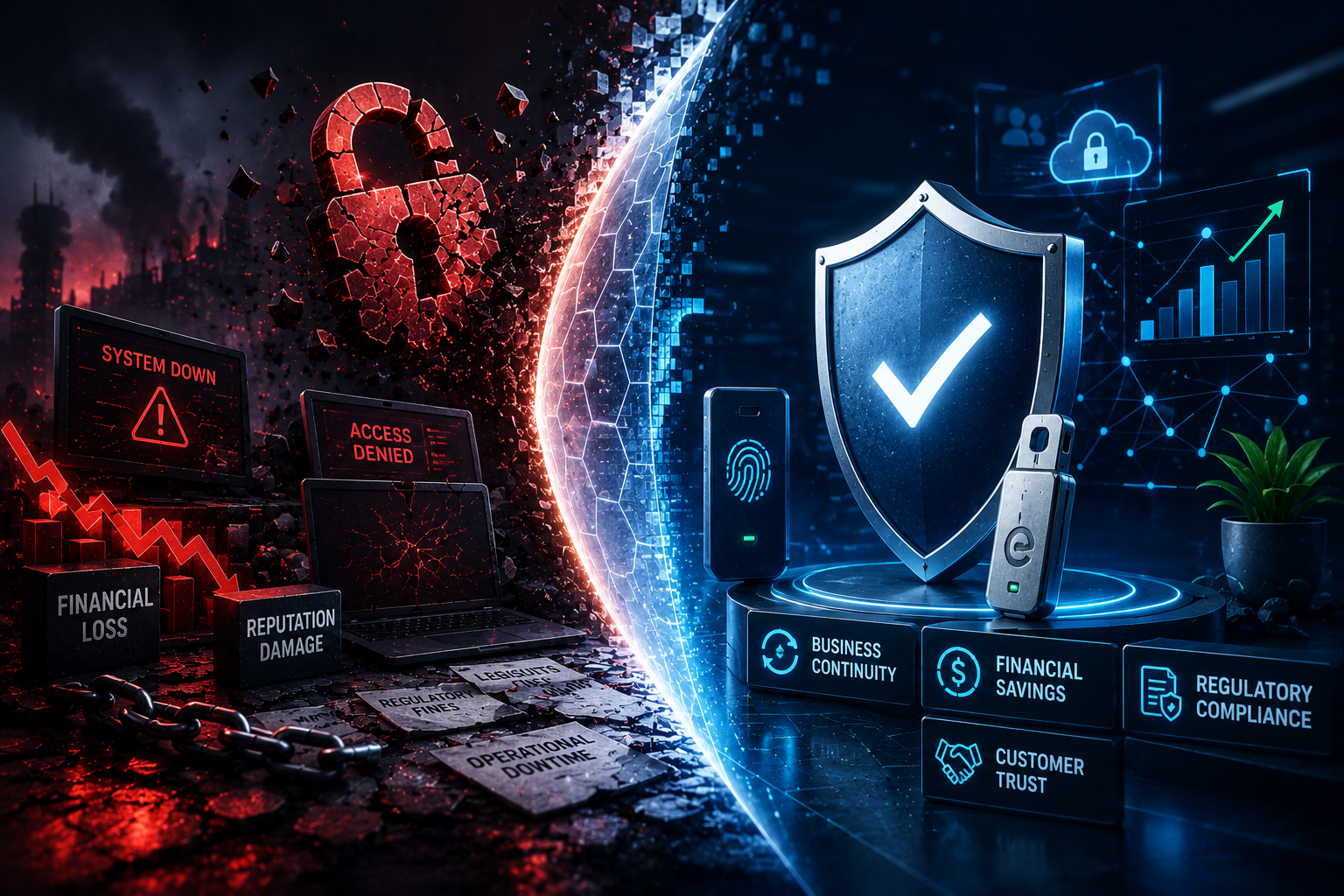
The Cost of a Breach vs The Cost of Prevention
Cyber Security

By Sreenivas K. | Published on May 15, 2026 | 4 min read
Cyber Security
By Sreenivas K. | Published on May 15, 2026 | 4 min read
In September 2025, one of the world’s most iconic automotive companies was brought to a standstill.
Jaguar Land Rover, a global manufacturing giant producing thousands of vehicles daily across multiple countries- suffered a devastating cyberattack that forced shutdowns across factories, dealerships, logistics systems, and supplier networks.
What began as an IT incident rapidly escalated into a manufacturing crisis.
Production lines stopped.
Employees were told to stay home.
Dealer systems failed.
Vehicle registrations stalled.
Global operations froze.
The numbers were staggering.
Reports estimated the attack cost Jaguar Land Rover nearly £50 million per week during operational shutdowns.
Later estimates suggested the broader economic damage to the UK economy crossed £1.9 billion ($2.5 billion), affecting more than 5,000 organisations across the supply chain.
And perhaps most importantly:this was not a failure of manufacturing.
It was a failure of identity security.
Investigators later linked the attack chain to compromised credentials and stolen access systems.
One compromised identity eventually cascaded into:
1. halted production,
2. frozen operations,
3. supply chain disruption,
4. financial losses,
5. and national economic impact.
This is the modern cybersecurity reality:breaches no longer stay inside the IT department.
They become business crises.
This is precisely why leading enterprises are increasingly partnering with Ensurity to strengthen enterprise authentication through hardware-backed identity, passwordless authentication, and enterprise-grade authentication governance.
To discover how ThinC-AUTH, XSense, and AMS can help secure your enterprise against modern identity-based attacks, reach out to us at: info@ensurity.com
For years, cybersecurity spending was viewed as defensive overhead.
Something enterprises invested in reluctantly.But modern breaches have fundamentally changed that equation.
Today, the cost of recovery massively outweighs the cost of prevention.
According to IBM’s Cost of a Data Breach research, the global average cost of a breach has crossed $4.45 million, with identity compromise and credential theft remaining among the most common entry vectors.
And these are only direct costs.
The real financial impact often includes:
1. Operational downtime
2. Supply chain disruption
3. Regulatory penalties
4. Customer churnInsurance increases
5. Recovery consulting
6. Lost productivityBrand damage
For manufacturing, finance, healthcare, automotive, and critical infrastructure industries, downtime itself can become catastrophic.
In many enterprises, every hour of operational disruption translates directly into:
1. lost revenue,
2. delayed logistics,
3. halted manufacturing,
4. customer dissatisfaction,
5. and contractual penalties.
Which is why the economics of cybersecurity are changing.
The question is no longer: “How much does security cost?”
The real question is: “How expensive is recovery?”
The majority of modern breaches no longer begin with sophisticated malware. They begin with a compromised identity. Credentials remain one of the most exploited attack vectors because traditional authentication systems still rely heavily on:
1. Passwords
2. OTPs
3. Shared secrets
4. Session trust
5. Human verification assumptions
But attackers have become extremely effective at exploiting these systems. Modern attacks now combine:
1. Credential theft
2. MFA fatigue attacks
3. Social engineering
4. PhishingSession hijacking
5. Identity impersonation
The result is a dangerous imbalance: enterprises are protecting billion-dollar operations with authentication systems originally designed for the early internet era.
This is why passwordless authentication is rapidly becoming foundational enterprise infrastructure. Modern FIDO2 authentication systems fundamentally change the trust model by eliminating shared secrets and introducing hardware-backed cryptographic identity.
Unlike passwords, a FIDO2 security key cannot simply be guessed, reused, or remotely stolen in the same way.
This dramatically reduces exposure to:
1. Credential theft
2. Session hijacking
3. Phishing attacks
4. Identity compromise
5. Unauthorized access escalation
And most importantly: it significantly reduces the financial risk attached to identity compromise.
At Ensurity, one of the strongest examples of this philosophy is the ThinC-AUTH Desktop BioPro, specifically designed for enterprise and corporate environments.
Unlike consumer-grade authentication devices, the ThinC-AUTH Desktop Key is built for:
1. Enterprise-scale deployment
2. Shared system environments
3. Corporate identity workflows
4. Multi-platform authentication
5. High-security operational ecosystems
Most importantly, the Desktop Key enables enterprises to securely store up to three credentials on a single key, making it ideal for employees handling multiple enterprise systems and access layers.
This enterprise FIDO2 key simplifies enterprise authentication while significantly reducing costs for organizations employing thousands of employees.
One of the biggest problems enterprises face is not simply authentication. It is authentication governance.
Large organisations must manage:
1. Employee onboarding
2. Vendor accessTemporary credentials
3. Device provisioning
4. Revocation workflows
5. Compliance visibilityAudit readiness
This is where Ensurity’s AMS (Asset Management System) and biometric keys ecosystem becomes critical. AMS transforms authentication from a login mechanism into a fully governed enterprise identity infrastructure.
With AMS, enterprises gain:
1. Centralized authentication lifecycle management
2. Vendor management workflows
3. Import and provisioning workflows
4. Secure onboarding systems
5. Centralized inventory visibility
6. Authentication policy control
7. Compliance and audit readiness
8. Enterprise-wide device orchestration
This becomes especially important in vendor-heavy industries where third-party access can dramatically increase cybersecurity risk.
AMS enables enterprises to:
1. control access centrally,
2. provision authentication securely,
3. revoke credentials instantly,
4. and maintain full visibility across the authentication ecosystem.
In modern cybersecurity, visibility itself becomes protection.
The cybersecurity conversation is changing. The comparison is no longer:
“passwords versus devices.
”The real comparison is: “the cost of prevention versus the cost of operational collapse.”
A hardware-backed authentication ecosystem costs a fraction of:
1. one ransomware payout,
2. one week of downtime,
3. one halted production line,
4. one regulatory penalty,
5. or one major identity breach.
This is why enterprises globally are rapidly moving towards:
1. Passwordless authentication
2. FIDO based authentication
3. Hardware-backed identity systems
4. Enterprise authentication governance
5. Passwordless authentication solutions
Not because it is fashionable.
Because the economics of breach recovery are becoming unsustainable.
The future of cybersecurity will not belong to isolated security products.
It will belong to integrated identity ecosystems that combine:
1. Hardware-backed trust
2. Authentication governance
3. Lifecycle management
4. Passwordless authentication
5. Identity visibility
6. Cryptographic protection
This is the future Ensurity has been building towards.
Because in modern enterprise security, authentication is no longer simply about access.
It is about ensuring that one compromised identity never becomes a billion-dollar crisis.