Collapse Arrow

Enterprise Identity & Access Management  for the AI Era.

Two server racks separated by a dotted line with a double-headed arrow between them, representing isolated or air-gapped systems.

Hardened
Air-Gapped IAM

Icon of a browser window showing binary code and a large key symbol overlapping the window, representing a session key or encryption concept.

Harden
SSH/API/Session keys

Browser window outline with a padlock and a check mark inside, surrounded by a circular arrow indicating continuous authentication or security verification.

Continuous
Authentication

Diagram of two computer monitors connected by lines to two rectangles with three dots each, representing a network or machine binding setup.

Machine &
Device Binding

TRUSTED BY ENTERPRISES WORLDWIDE

THE ENSURITY ECOSYSTEM

One Ecosystem.
Multiple Layers of Trust.

The Passwordless Shift

DEPLOYING PASSKEYS?
Make sure they're Secure

Passkeys require enterprise-grade management, device binding and hardened deployment.
‍
Discover how Ensurity helps enterprises secure and manage passkey deployments, including air-gapped environments.

BUILT FOR THE REAL WORLD

Complex Identity Problems Ensurity Solves

From cross-OS authentication to air-gapped environments, Ensurity helps enterprises secure what matters.

Icon of a desktop computer monitor centered between two smartphones, connected by lines to symbolize cross-device connection or synchronization.
Cross-OS Authentication
Icon of a sandbox with two mounds of sand and a shovel stuck in one mound.
Sandboxing
Two server racks separated by a dotted line with a double-headed arrow between them, representing isolated or air-gapped systems.
Air-Gapping
Network diagram icon showing four computer monitors each connected to a central device, representing device binding or network connection.
Machine & Device Binding
Icon of a computer window with a brick wall in front and a shield bearing a padlock symbol, representing firewall and VPN security.
Firewalls, VPNs & Linux Servers
Outline of a person surrounded by a circular arrow connecting a lock at the top, a shield with a checkmark on the left, and a fingerprint on the right, representing credential security and identity verification.
Credential Lifecycle Management
Icon of a purple padlock with a finger pressing its keyhole, connected to circuit-like lines representing secure access control.
Granular Access Control
Browser window outline with a padlock and a check mark inside, surrounded by a circular arrow indicating continuous authentication or security verification.
Continuous Authentication
Icon of a command line interface with the text 'SSH' and a stylized key on the right, representing SSH key access.
SSH Keys
Icon of a browser window showing binary code and a large key symbol overlapping the window, representing a session key or encryption concept.
Session Keys
Outline of a cloud with the text 'API' inside and a key icon overlapping the bottom left of the cloud, representing an API key.
API Keys
Purple key symbol with a hexagonal head resembling a nut, connected to digital circuit lines extending from the key's shaft, representing a digital security or cryptographic key concept.
Agent Keys

INSIGHTS FOR A SAFER TOMORROW

Use Cases

Explore how enterprises use Ensurity to secure identities, strengthen access and protect critical systems.

FREQUENTLY ASKED QUESTIONS

Have Questions?
We Have Answers

What is FIDO2 authentication?

FIDO2 authentication is a modern, standards-based approach to secure, passwordless authentication. It combines the WebAuthn and CTAP standards to enable users to authenticate using a FIDO2 security key, passkey or supported device authenticator, instead of relying on traditional passwords.

A FIDO2 security key uses public-key cryptography to verify a user's identity without transmitting a reusable password to the server. This makes FIDO2 authentication highly resistant to phishing, credential theft and replay attacks.

Ensurity's ThinC-AUTH range of FIDO2 security keys enables hardware-backed, phishing-resistant authentication for enterprise environments. It supports passwordless authentication solutions while also providing a strong foundation for multi-factor authentication (MFA).

FIDO2 authentication is increasingly becoming a preferred alternative to passwords, traditional smart card authentication and vulnerable one-time password methods.

How does Ensurity help enterprises defend against phishing?

Ensurity helps enterprises strengthen identity security through hardware-backed, phishing-resistant authentication and enterprise credential management.
Traditional password-based authentication can expose organisations to phishing, credential theft, account takeover and social engineering attacks. Even multi-factor authentication can be targeted through techniques such as MFA fatigue, session hijacking and adversary-in-the-middle attacks.

Ensurity addresses these risks through:

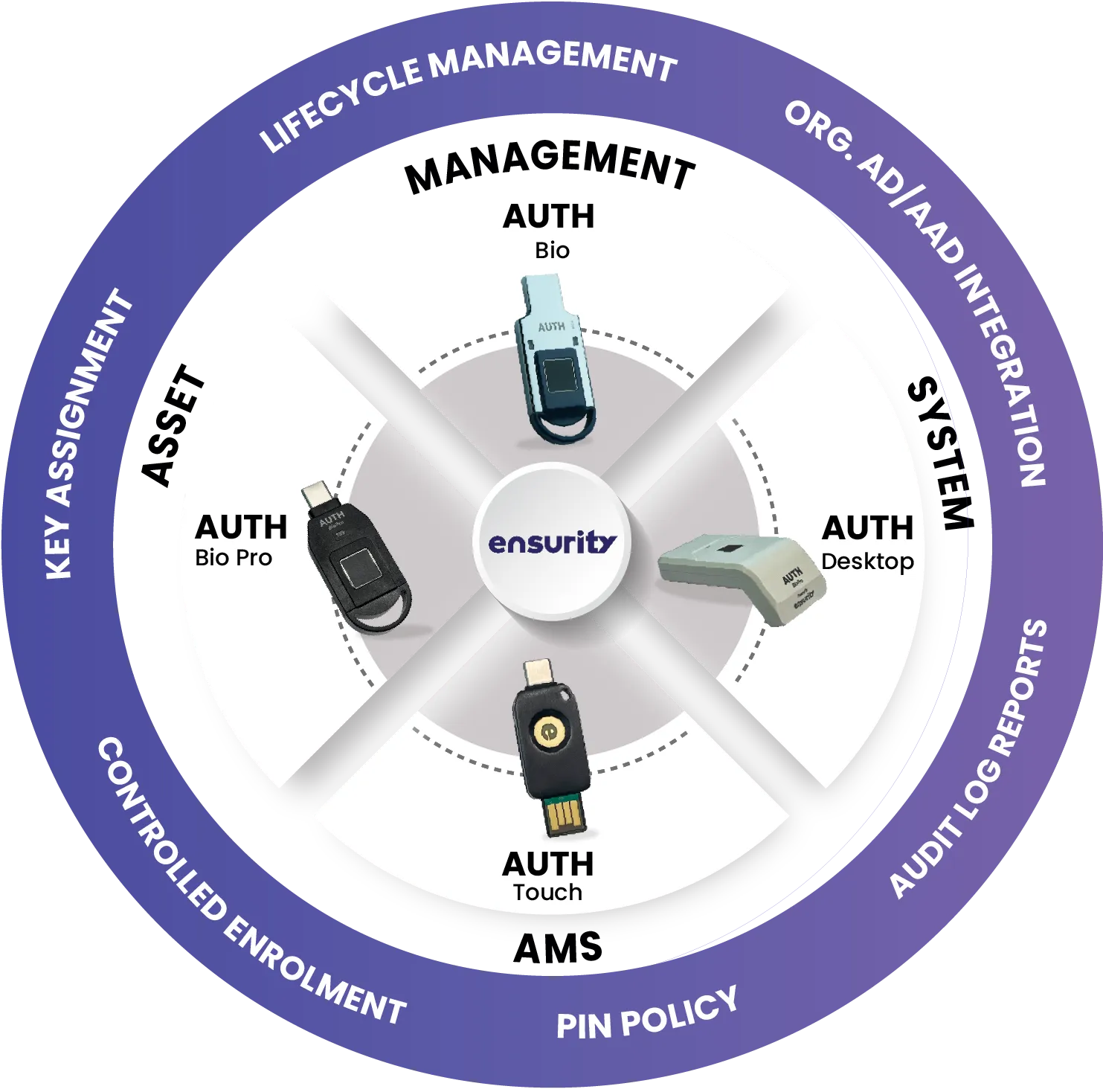
  • ThinC-AUTH FIDO2 security keys: Hardware-backed authentication using cryptographic credentials rather than reusable passwords.
  • AuthAMS: Credential and asset lifecycle management, including key and machine binding.
  • XSense IdP: Enterprise identity and access management for controlling and managing authentication across enterprise applications.

Together, these capabilities help organisations reduce their dependence on passwords, strengthen privileged access and implement more secure passwordless authentication solutions.

What is AuthAMS?

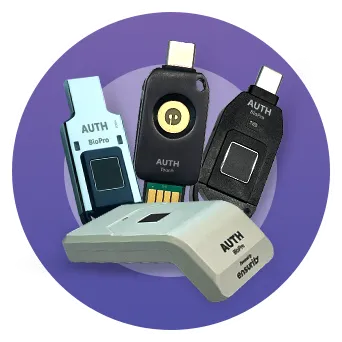
AuthAMS is Ensurity's Authentication and Asset Management System, designed to manage authentication credentials and associated assets across their lifecycle.

Enterprise environments have to manage multiple security keys, credentials, machines and access points. Without centralised credential lifecycle management, organisations can struggle to maintain visibility and control over these assets.

AuthAMS helps enterprises manage this environment through capabilities such as:
  • Credential and asset lifecycle management.
  • Security key and machine binding.
  • Credential association with authorised devices.
  • Management of authentication assets across their lifecycle.

AuthAMS complements FIDO2 authentication by adding an enterprise management layer to passwordless authentication security. It helps organisations strengthen control over the credentials and devices used to access critical business systems.

What is cross-OS authentication?

Cross-OS authentication enables users to authenticate securely across different operating systems and computing environments without depending on a separate password-based authentication method for every platform.

Enterprises often operate across multiple environments, including Windows desktops, macOS devices, remote desktop infrastructure and other supported enterprise systems. Managing different authentication methods across these environments can increase complexity and create security gaps.

Ensurity's passwordless authentication solutions are designed to support authentication across supported operating systems and enterprise use cases through hardware-backed FIDO2 security keys.

This helps organisations establish a more consistent authentication experience across their IT infrastructure, including supported desktop, remote access and enterprise application environments.

What is sandboxed biometric authentication?

Sandboxed biometric authentication is an approach in which biometric processing is isolated within a protected environment, helping reduce exposure of sensitive biometric information to other applications or processes.

Traditional biometric authentication relies on characteristics such as fingerprints or facial recognition to verify a user's identity. However, biometric data needs to be handled carefully because, unlike passwords, biometric characteristics cannot simply be changed if compromised.

Ensurity incorporates sandboxed biometric authentication into its security approach to strengthen the protection of biometric verification. By isolating biometric processing, the approach helps limit exposure while supporting secure authentication.

When combined with FIDO2 authentication and hardware-backed cryptography, biometric passkeys can provide a convenient and secure way to authenticate users without relying on reusable passwords.

Can Ensurity support air-gapped environments?

Yes. Ensurity supports authentication use cases for environments where systems operate without direct connectivity to the public internet, including air-gapped networks, subject to the deployment architecture and application requirements.

Air-gapped environments are used by organisations that need to isolate critical infrastructure from external networks. However, users and administrators still require secure access to these systems.

Ensurity's FIDO2-based authentication approach and hardware security keys can support suitable on-premises authentication deployments, helping organisations reduce dependence on passwords even in restricted network environments.

This makes hardware-backed passwordless authentication relevant for critical infrastructure, secure enterprise networks and other environments where conventional cloud-dependent authentication may not be suitable.

What is machine binding and device binding?

Machine binding and device binding are security mechanisms that associate authentication credentials with authorised machines or devices.

A credential that can be used without sufficient device-level controls may create additional exposure if it is copied, transferred or used from an unauthorised environment.

With AUTHAMS, Ensurity provides key and machine binding capabilities that help enterprises establish stronger relationships between authentication credentials, security keys and authorised machines.

These controls support enterprise credential management by helping organisations maintain greater control over where and how authentication credentials are used.

Machine binding and device binding are particularly relevant for privileged accounts, administrator access, financial systems and other critical enterprise applications.

What is credential lifecycle management?

Credential lifecycle management refers to the processes involved in managing authentication credentials throughout their lifecycle, from provisioning and onboarding to usage, maintenance, revocation and retirement.

Enterprises manage a growing number of credentials, including passwords, FIDO2 security keys, passkeys, API keys, session credentials and other authentication assets. Without effective management, credentials can remain active beyond their intended use or become difficult to track.

Ensurity's AUTHAMS provides credential and asset lifecycle management capabilities that help enterprises manage authentication assets and strengthen control over their usage.
Effective credential lifecycle management is an important part of passwordless authentication security, particularly when organisations deploy FIDO2 security keys and passkeys at scale.

Does continuous authentication replace initial sign-in?

No. Continuous authentication does not replace the initial sign-in process. It complements it by providing additional verification of trust during an active session.

Initial authentication establishes a user's identity when access is requested. Continuous authentication can then help assess whether the user's access should remain trusted as the session progresses, depending on the signals and controls implemented by the organisation.

This is particularly relevant for sensitive applications, privileged accounts and critical enterprise systems where access risk can change after the initial login.

By combining strong initial authentication with continuous authentication and appropriate access controls, organisations can build a stronger identity security framework.

What is XSense ID (XSense IdP)?

XSense IdP is Ensurity's enterprise Identity Provider (IdP), designed to support enterprise identity and access management.

An Identity Provider manages user authentication and helps organisations control access to applications and enterprise resources. It plays a central role in establishing and enforcing authentication policies across an organisation.

XSense IdP forms the enterprise identity layer within Ensurity's authentication ecosystem. It works alongside ThinC-AUTH FIDO2 security keys and AUTHAMS to support passwordless authentication, stronger identity verification and controlled access.

Together, these capabilities help enterprises move beyond traditional passwords towards a more secure and manageable identity and access architecture.

Get Started

Want your IAM to be ready for AI era?

Talk to our experts about your identity security requirements.

Thank you! Your submission has been received!
Oops! Something went wrong while submitting the form.